


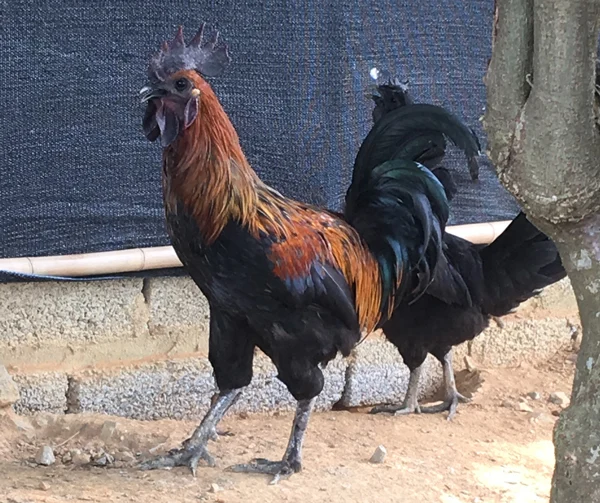
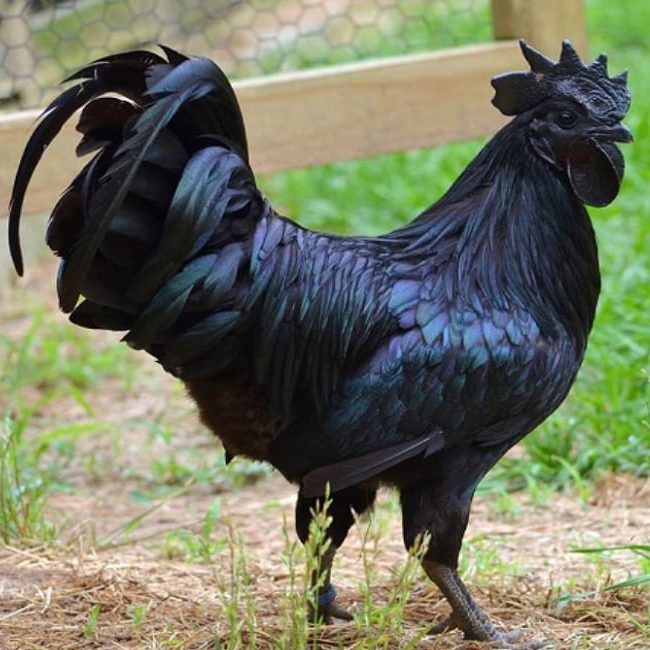


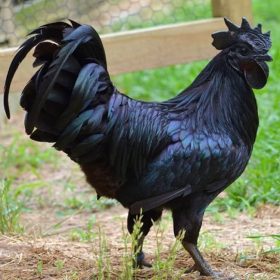
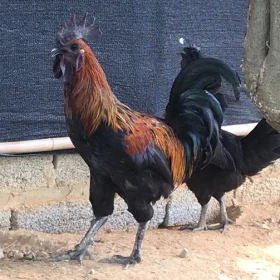
Hmong chicken, also known as Mong chicken, black Mong chicken, or Meo chicken, is a native Vietnamese chicken breed originating in the northern mountainous region. It is raised extensively by the Hmong people, who maintain the original breed and consider it a specialty chicken. The Hmong chicken is a rare breed, characterized by its black meat and bones, low fat content, and firm, flavorful meat – considered among the best chicken breeds in Vietnam today. Besides being used as food, the Hmong people also make a medicinal broth from it to improve their health. Currently, commercially raised Hmong chicken is considered a delicacy.
This breed is characterized by its large size, bushy comb, and abundant feathers, most commonly apricot, black, or pure white. H’Mong chickens have very little fat, firm, flavorful, and sweet meat, and their bones and meat can be used in traditional medicine. Generally, their meat and bones are black, they have four claws, and the low fat content in the meat makes them not greasy. The meat is particularly firm, crispy, and delicious. On average, an adult chicken weighs between 2 and 3 kg. Chickens raised for about 5 months reach a weight of 1.5-1.8 kg and begin laying eggs.
One-day-old chicks, both male and female, have reddish-brown, reddish-black, and striped feathers. Adult chickens have a balanced build, tall black legs, and diverse feather colors; most have black skin and internal organs, with a few having white skin and white meat. Hmong chickens have delicious, lean meat and are considered by consumers to be a medicinal and nourishing breed. Black Hmong chickens are very similar to wild chickens and black chickens, so many varieties of black Hmong chickens are available on the market today, but they are mostly hybrids. The biggest difference is that genuine black Hmong chickens have completely black heads, combs, four-toed feet, and black blood and internal organs. The average weight of an adult black Hmong chicken is 2 to 3 kg, with some weighing over 3.5 kg. Their meat is lean and firm. In contrast, black chickens have five toes, red combs, or feathers on their combs and lower legs.
For breeding chickens, the survival rate is 93% at 8 weeks old and over 85% at 20 weeks old. At 8 weeks old, the body weight of male chickens is 747g and 626g for female chickens. At 20 weeks old, male chickens weigh 3kg and female chickens weigh 2.8kg. During the egg-laying period, the chickens’ body weight continues to increase. At 38 weeks old (9 months), male chickens weigh 2023g and female chickens weigh 1565g. Feed consumption per chicken from 1-9 weeks is 1.95kg, from 10-20 weeks it is 5.7kg/hen, and feed consumption for 10 eggs is 3.26kg.
Chickens lay their first egg at 140 days old. Egg production gradually increases over the weeks of laying and peaks at 30 weeks old (50%), then gradually decreases and remains at 27-37% due to brooding and molting. At 60 weeks of age, the egg production per hen is 92 eggs. The weight of H’Mông chicken eggs stabilizes at 45g. When the eggs are placed in incubators, a high fertilization rate (98%) and a hatching rate of 88% of the total eggs incubated are observed.
Related products
Plants and Seedlings
Plants and Seedlings
Plants and Seedlings
Foods
Plants and Seedlings
Plants and Seedlings

Plants and Seedlings
Plants and Seedlings